Wednesday, June 19, 2013

Petoskey stone

My Dad was here for a week and we spent our time organizing and consolidating my files. But the first day of his visit, we went through my keepsakes. I sent some home with him, set some aside for my Mom, mailed some to my sister, and found a few more treasures I wanted to add to the cabinet in my room. When my friend Sue came by yesterday, I showed her that Dad and I had reorganized the display and pointed out a small polished stone in the front. As I reminisced about receiving it from our neighbor Mr. Lanach when I was small child, Sue picked it up and held it in her hand. "That's a Petoskey stone," she said, thereby identifying the mysterious stone that had been in my possession for more than 40 years! Petoskey stones (IMAGE ABOVE) are fragments of a coral reef that was originally deposited during the Devonian period. Glaciers plucked the stones from the bedrock, ground off their rough edges, and deposited them on the shores of Lake Michigan. The movement of the lake ice during the winters exposes new Petoskey stones at the water's edge each spring. Like the one I have, they are often polished to bring out the distinctive mottled pattern of the six-sided coral (Hexagonaria percarinata). The name of the stones – and that of the city of Petoskey, Michigan - comes from Ottawa Indian Chief Petosegay, whose mother named him after the rays of sun that fell upon his newborn face. The word means "rising sun," "rays of dawn," or "sunbeams of promise."

Tuesday, June 18, 2013

Impermanent press

With the advent of electronic books, there was concern among publishers that the traditional book would disappear. That of course hasn't happened, but an independent Argentinian publisher has produced books with words that disappear. To make sure first-time authors get read, Eterna Cadencia* initiated a new concept of printing books with specially-developed ink that, as it comes into contact with light and air, gradually fades away over the course of 2 months (VIDEO HERE). The first in the series was a 2010 anthology of new Latin American writers. Titled El Libro que no Puede Esperar [The Book that Can't Wait], the volume sold out in the first day. The disappearing ink does not allow readers and reviewers to procrastinate, thereby giving the authors a chance at continuing their careers. As the promo points out, "If people don't read their first books, they'll never make it to a second."

* This link won't work for me, but it's the official publisher website.

Monday, June 17, 2013

Big-ass atlas

As I mentioned in an earlier post, this is the book I dreamed about before I knew it existed. The Klencke atlas, as it is known, measures 5' 10" (1.78m) high by 3' 5" (1.05m) wide by 4" (11cm) thick. It had never been publicly displayed with its pages open until 2010, when the British Library featured it in an exhibition about cartography. The book, containing 42 maps, is so heavy that it requires 6 people to lift. The Library's head of antiquarian maps Tom Harper notes, "Even standing beside it is quite unnerving." Its reputation as the world's largest atlas – superseded only in 2012 – stood for 352 years. The Klencke Atlas was bound in Amsterdam in 1660 and presented by a consortium of Dutch merchants to King Charles II of England (1630-1685) to mark his restoration to the throne. It was kept in the king's cabinet of curiosities during his lifetime, donated to the British Library by a successor in 1828, and restored and rebound in the 1950s.

Sunday, June 16, 2013

Mammoths not massacred!

Contrary to popular belief, Stone Age Siberians did not slaughter mammoths in great numbers. Researchers Pavel Nikolskiy and Vladimir Pitulko of the Russian Academy of Sciences have determined that their ancient hunting patterns were not responsible for the animals' extinction. When they did kill, the natives definitely exploited the mammoth's vulnerabilities. “Yana people definitely attacked from the mammoth’s blind spot,” says Nikolskiy. He and his colleague assessed 1,103 bones from at least 31 mammoths that had accumulated at Yana over 2,000 years and found that while Siberian people ate mammoth meat after hunts, food was not their primary goal. They needed the ivory of their curved tusks to make tools and hunting weapons. But unlike many of their North American and European counterparts, the Siberians only sought out the mammoths every few years.

Saturday, June 15, 2013

Conspirator cover

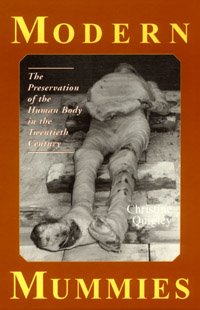
Jesuit priest Father Henry Garnet (1555-1606) was hanged for treason for his part in the Gunpowder Plot, a failed assassination attempt against England's King James I in 1605. According to legend, an image of his face appeared on a piece of bloodstained straw found at the scene of his execution. Shortly thereafter, a book entitled A True and Perfect Relation of The Whole Proceedings against the Late most barbarous Traitors, Garnet a Jesuit and his Confederats was printed in London. On a specially-bound volume, the priest's face again appeared: "It's a little bit spooky because the front of the book looks like it has the face of a man on it, which is presumed to be the victim's face," describes auctioneer Sid Wilkerson. He sold the book (PICTURED ABOVE) – contained in a box measuring 11" x 7" x 5" (28 cm x 19 cm x 13 cm), equipped with a handle, decorated with brass, and closed with an iron clasp – in 2007 for £5,400. But the face on the cover is not the most curious thing about it. That would be the belief that it was bound in the priest's own skin...

Friday, June 14, 2013

Cheetah chase

We've heard from a young age how quickly cheetahs can sprint across the African savanna to take down their prey. Now British researchers at the Royal Veterinary College’s Structure & Motion Laboratory have put that to the test and determined that it is not speed alone which accounts for their effectiveness. They outfitted 5 wild adult cheetahs (3 females and 2 males that are part of a population under continuous study in the Okavango Delta region of northern Botswana) with a special collar they designed. It weighs only 12 ounces (340 g), is solar-powered, and provides an unprecedented amount of data that can be downloaded by radio. Its features include GPS, accelerometers, gyroscopes, and magnetometers, which indicate position, posture, and balance. Over a 17-month period, the scientists analyzed 367 verified hunting runs– 26% of which were successful – and found that the animals maintained their top measured speed of 58 mph (93 km) for only a second or two. "[T]he big cats’ hunting successes were based on maneuverability and behavior rather than simply speed. According to their study, published today in Nature, the cheetah’s ability to accelerate and decelerate rapidly without losing its footing, and to turn tightly at moderate speeds, appears to be more important than being flat-out fast."

Thursday, June 13, 2013

Package of poop

People who don't pick up after their dogs are reviled the world over. Communities in the U.S. have turned to companies offering to DNA test dog feces to identify wayward owners. A city in Taiwan encouraged clean-up by offering lottery tickets for a chance to win a gold ingot to those who turned in their dog's messes. In February, the small town of Brunete, Spain, took a stealthy and hands-on approach to their problem following an amusing ad campaign (VIDEOS HERE). They enlisted volunteers to keep an eye on dog-walkers. They approached those who didn't scoop and casually obtained the pet's name and breed. They secretly collected and labelled the dog doo for town officials, who looked up owners' addresses in their database of registered pets and delivered the poop to them in a special box. A cameraman recorded their reactions as they signed for the packages marked "lost property." The less aromatic contents of the boxes promised a fine if the act were repeated. Anecdotal evidence suggests that abandoned eliminations have been eliminated by as much as 70%. "We didn’t have volunteers tallying up the poo before and after the campaign; our results are based on what neighbors have told us," says the town hall spokesperson.


Wednesday, June 12, 2013

X-rayed aria

After the debut of the opera Médée by Luigi Cherubini (1760-1842) in Paris in 1797, reviewers commented that it was too long. The Italian composer scratched out the aria called "Du trouble affreux qui me dévore" ["The terrible disorder that consumes me"] and the opera has been performed without it ever since. Scientists at Stanford University's National Accelerator Laboratory - who recovered Archimedes' lost writings a few years ago - have now successfully applied their x-rays to Cherubini's musical score. By sorting out the iron in his ink, the zinc on the pre-printed paper, and the charcoal he used to scrub out the section, they have restored the opera so that it can now be performed in its entirety for the first time in more than 200 years. Physicist Uwe Bergmann describes, "It was amazing to be able to see the complete aria. For me, uncovering the composition of a genius' work that had been lost for centuries is as thrilling as trying to uncover one of the big secrets of nature." Listen to part of the opera here and the missing aria here.

Tuesday, June 11, 2013

Bronze Age boats

"There was huge excitement over the first boat, and then they were phoning the office saying they'd found another, and another, and another..." remembers conservator Ian Panter of the York Archaeological Trust about the day archaeologists discovered 8 bronze age log boats in a quarry in Peterborough, Cambridgeshire, U.K. (PHOTOS HERE). The boats are still remarkably preserved after 3,000 years. Currently under refrigeration, they are being conserved and displayed at the Flag Fen archaeology site. One measures almost 28' (8.5 m) long, another (IMAGE ABOVE) is covered with decorative carvings, and several had patches and plugs. There was a vessel with handles for lifting it out of the water and another with traces of fire on the deck where the fishermen cooked their catch. For reasons unknown, the boats had been deliberately sunk and were preserved beneath the silt in the bed of a dried-up creek. Site director Kerry Murrell, remarked: "Some show signs of long use and repair – but others are in such good condition they look as if you could just drop the transom board back in and paddle away." In fact, you could! Unlike some of the replicas made over the past few years, one of the original vessels – carved of solid oak – was still so light and buoyant that when the excavated trench filled with rainwater, the archaeologists were able to float it into its cradle for lifting and transportation.

Monday, June 10, 2013

One million bones

"I wish you were here to see this," wrote my friend Jody Arlington in an e-mail yesterday that included the photo above. Jody – who is now reviewing graphic novels for NPR – and I have been to many art exhibits together in and around Washington, D.C. This striking installation is a carpet of 1,018,260 human bones placed on the National Mall by volunteers on Saturday morning and on display until this afternoon. The bones are not real (they have been hand-crafted from diverse materials by many contributing artisans), but the genocide that they symbolize is real. New Mexico-based and socially conscious artist Naomi Natale began her project "One Million Bones" (VIDEOS HERE) in 2010 to raise awareness of the mass killing in Sudan, Congo, Burma, and Somalia. With preview installations in Albuquerque in New Orleans, the event on the National Mall began with the bone-laying ceremony and included a candlelight vigil, performances, and speeches by experts on human rights. "Natale hopes that viewers will not only confront a powerful, if morbid, symbol of faraway suffering, but recognize the fragility of our own lives, and our connectedness to victims we only hear about on the news. 'We belong to each other,' she says."

Sunday, June 9, 2013

Mini mother ship

"I look forward to seeing your cars out on the road," said American President Barack Obama to 33-year-old Austin entrepreneur Stacy Zoern on May 9, 2013. Born with a disability, Zoern was making a presentation at a Texas think-tank to discuss funding the all-electric smart car she has developed for the physically handicapped. The Kenguru (IMAGE ABOVE, VIDEO HERE) allows a person in a wheelchair to drive right inside and take over the controls, which are all at hand-level. It has a range of 60 miles (96 km), a top speed of 28 miles (45 km) per hour, and a price-tag of about $25,000. With orders for 600 units already and many more expected, production will start this summer in Titusville, Florida. Zoern herself does not have the upper body strength to drive the current model, but plans are in the works to roll out a Kenguru controlled by a joystick. Unlike my own mother ship, the tiny car is only 7' (2 m) long and weighs 1,200 lbs (544 kg), filling a need and appealing to a changing sense of style. As Zoern points out, “Teenagers and people in their 20s don’t want to drive around in a minivan.”

Saturday, June 8, 2013

Below

Bedrock beneath: Unlike the North Pole, which is situated on (rapidly disappearing) floating ice, the South Pole is located on a landmass. But until now, we have not been able to visualize in detail the surface of the continent of Antarctica. Researchers at the British Antarctic Survey have used satellite and surface data collected over decades to strip away the sea ice, glaciers, and ice sheets to reveal the Antarctic topography (VIDEO HERE). Says team leader Peter Fretwell, "Before, we had a regional overview of the topography. But this new map, with its much higher resolution, shows the landscape itself, a complex landscape of mountains, hills and rolling plains, dissected by valleys, troughs and deep gorges."

Beneath bedrock: Almost 2 miles deep in a Canadian mine, at the level of what used to be the ocean floor, isotope geochemist Barbara Sherwood Lollar and her colleagues at the University of Toronto found the most ancient pocket of untouched water discovered to date. They used a device that measures levels of stable elements (hydrogen, carbon, and nitrogen) and noble gases (helium, xenon, and krypton) to determine – knowing how long it takes for chemicals to react between rocks and water – how long the fluid had been trapped in the deep crust. As it turns out, the water predates the development of multi-cellular life on the planet. Lollar exclaims, "It was absolutely mind-blowing, These weren't tens of millions of years old like we might have expected, or even hundreds of millions of years old. They were billions of years old."

Friday, June 7, 2013

Crazy sloth ladies

Sloths are difficult to maintain in captivity, and should never be kept as pets. With that said, let me tell you about 2 women who have made sloths their cause:

Thursday, June 6, 2013

Trio of Triceratops

This fall, a rancher near Newcastle, Wyoming, noticed large bones eroding from his land. He alerted scientists from the Black Hills Institute of Geological Research who partnered with the Dutch company Naturalis Biodiversity Center to excavate beginning last month. During the Cretaceous period 65 million years ago, the area was likely a subtropical flatland and probably a Tyrannosaurus rex feeding ground. T. rex would normally eat the skin and bones of a triceratops – one of its favorite foods – and leave only the skull behind. But in this unprecedented find, the paleontologists have uncovered 3 complete Triceratops skeletons, 2 of them juveniles. President of the Black Hills Institute Pete Larson does not exaggerate when he remarks, "We have the opportunity to really rewrite the book on triceratops."

Wednesday, June 5, 2013

Scream…

… with laughter when you screen a short, wonderfully narrated video that my friend Sue linked me to. It's about the aye-aye, a prosimian that lives in Madagascar and forages for grubs by tapping tree trunks like a woodpecker with its freakishly long middle finger (IMAGE ABOVE). Watch "True Facts about the Aye-Aye" and you will be hooked on Ze Frank, the Executive Vice President of Video at BuzzFeed. I'm pleased to say that his YouTube channel has plenty more of these hilarious nature documentaries:

I'm going to be busy for a while…


HALLOWEEN-Click for captions

Loading...

Labels